




Mar 7, 2024 1:32 PM
During our time at Miss World we have many rehearsals day where we will be wearing more casual attire.
I have chosen to use this opportunity to bring awareness and highlight Irish charities, by wearing a different t-shirt from each of them for every rehearsal.
Today I am representing Clare Haven Horizons.
Eliminating Domestic Violence, Domestic Abuse And Coercive Control
They focus on primary prevention activities in the area of domestic violence, domestic abuse and coercive control including awareness, education, accredited training, research, collaborative partnerships and piloting international best-practice models.
Haven Horizons is a national voluntary organisation dedicated to the elimination of domestic, sexual and gender-based abuse (DSGBA). Over the last decade Haven Horizons has identified key actions, collaborative projects and international models of best practice that have the power to revolutionise Ireland’s response to DSGBA at a systemic level. Haven Horizons has established a National Gender-based Violence Research and Knowledge Centre that drives our innovative workplan which offers solutions to the gaps identified by the Third National Strategy and the Istanbul Convention.
Principles:
- A commitment to Zero Tolerance on violence and abuse against women and children
- Evidence-based research, survivors’ experiences and collective action
- The need to challenge and transform the societal attitudes, beliefs, behaviour and individual and organisational practices that tolerate and condone abuse and violence against women and girls.
Prevention
While the implementation of the Third National Strategy on Domestic, Sexual and Gender-Based Violence (2022-2026) has the potential to be transformative, the current gaps result in high levels of DSGBA, re-victimisation, attrition, low conviction rates, serious injury and homicide. To date responses and resources have focused predominantly on the protection. Despite this high level of investment, 2022 was the deadliest year of the decade for women and children (12 women and 5 children were murdered). It is now recognised that investment in prevention is crucial.
Models of Prevention:
Primary, Secondary and Tertiary Prevention of Domestic Abuse
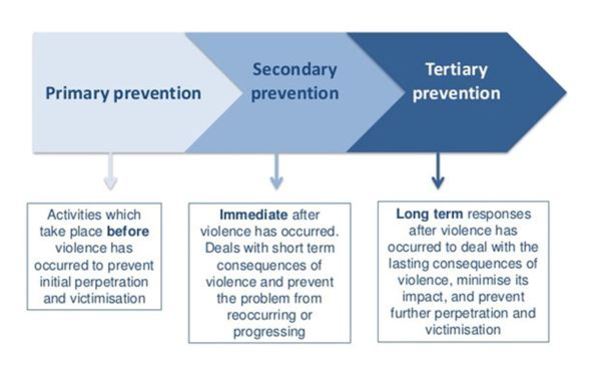
They are committed to supporting comprehensive prevention activities and systematic processes that eliminate domestic abuse and coercive control. The prevention of domestic abuse is can be categorised in three ways:
- Primary Prevention
Activities that take place before domestic abuse has occurred and are designed to prevent the abuse from happening. Examples of primary prevention include awareness, a wide range of education programmes, research, evidence-based pilot projects, activism and campaigns that change social norms, culture and legislation.
2. Secondary Prevention
Immediate responses after domestic abuse has occurred to provide services for the victims of abuse that deal with the immediate consequences of abuse. Examples of secondary prevention include refuges, support services and emergency helplines.
3. Tertiary Prevention
Long-term responses after domestic abuse has occurred to deal with the medium and long-term impacts of domestic abuse. Examples of tertiary prevention include long-term support for victims, ongoing advocacy and programmes for perpetrators.
A comprehensive response to domestic abuse involves all three types of prevention.
Spectrum of Prevention
Over the last forty years, the majority of efforts in response to domestic abuse have been led by the activism and actions of women’s groups to support victims and could be classified as secondary or tertiary forms of prevention. More recently there has been an increasing awareness that comprehensive prevention requires the causes (primary prevention) and the consequences to be addressed in a systematic way.
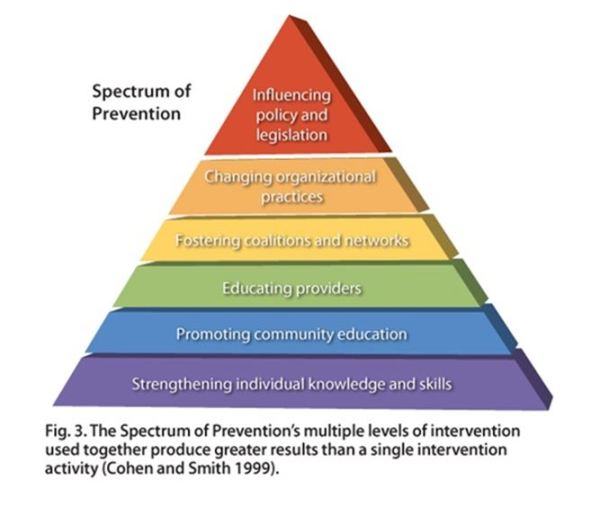
The Spectrum of Prevention model is a framework for developing multifaceted approaches to prevention which can help practitioners develop and structure comprehensive initiatives. The spectrum is comprised of six inter-related action levels: (1) strengthening individual knowledge and skills, (2) promoting community education, (3) educating providers, (4) fostering coalitions and networks, (5) changing organizational practices, and (6) influencing policy and legislation. Activities at each of these levels have the potential to support each other and promote overall community health and safety. The spectrum of prevention is a tool which can help practitioners and policy leaders move beyond a primarily educational approach to achieve broad community goals through prevention strategies that include policy development.
The Social-Ecological Model:
Prevention requires understanding the factors that influence DSGBA. The Centre for Disease Control and Prevention (CDC) uses a four-level social-ecological model to better understand DSGBA and the effect of potential prevention strategies. This model considers the complex interplay between individual, relationship, community, and societal factors.
The overlapping rings in the model illustrate how factors at one level influence factors at another level. Besides helping to clarify these factors, the model also suggests that in order to prevent violence, it is necessary to act across multiple levels of the model at the same time. This approach is more likely to sustain prevention efforts over time and achieve population-level impact.
“Violence against women is always a violation of human rights; it is always a crime; and it is always unacceptable. Let us take this issue with the deadly seriousness that it deserves“.
(Ban Ki Moon, United Nations Secretary General)
Comments

Powered by RoundtableBuilt on infrastructure designed for real-time media. Learn more at RTB.io.© Roundtable 2026. By using this site you agree to the Terms of Use and Privacy Policy